
7 in 10 People Found UK Tax Resident Spent Under 183 Days Here
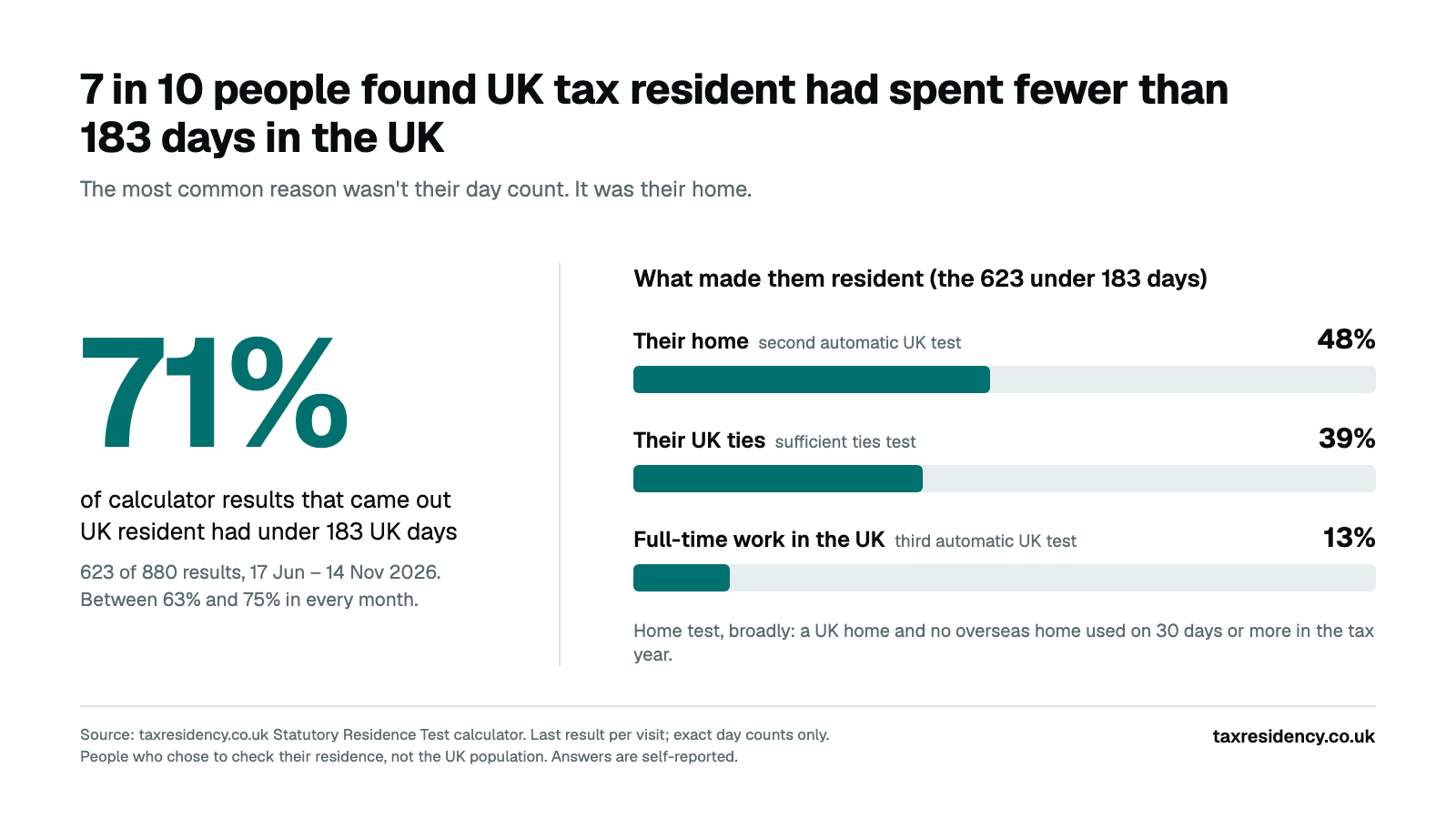
Our calculator data: 71% of people who came out UK resident had spent fewer than 183 days in the UK. The most common reason wasn't their days, it was their home.
The best-known rule in UK tax residence is the 183-day rule: spend 183 days or more in the UK in a tax year and you're automatically UK resident. Many people take the opposite to be true too, that staying under 183 days keeps them non-resident. It doesn't, and our own data shows how often that assumption fails.
Of the people who used our calculator and came out UK resident, 71% had spent fewer than 183 days in the UK. The most common reason wasn't how many days they'd spent here. It was where their home was.
Try it out for yourself
These figures come from our free calculator. Enter your own UK days, home and ties to see where you stand, and which test decides it, worked through in HMRC's order.
Try the free calculatorKey points
- 71% of calculator users who came out UK resident had spent fewer than 183 days in the UK (623 of 880, 17 June to 14 November 2026)
- The figure was 63-75% in every month, not a one-off
- The biggest single reason was home, not days: 48% were resident under the second automatic UK test, broadly having a UK home and no overseas home they used for 30 days or more
- Having a home abroad didn't protect them: two-thirds of the people caught by the home test (203 of 299) said they also had an overseas home
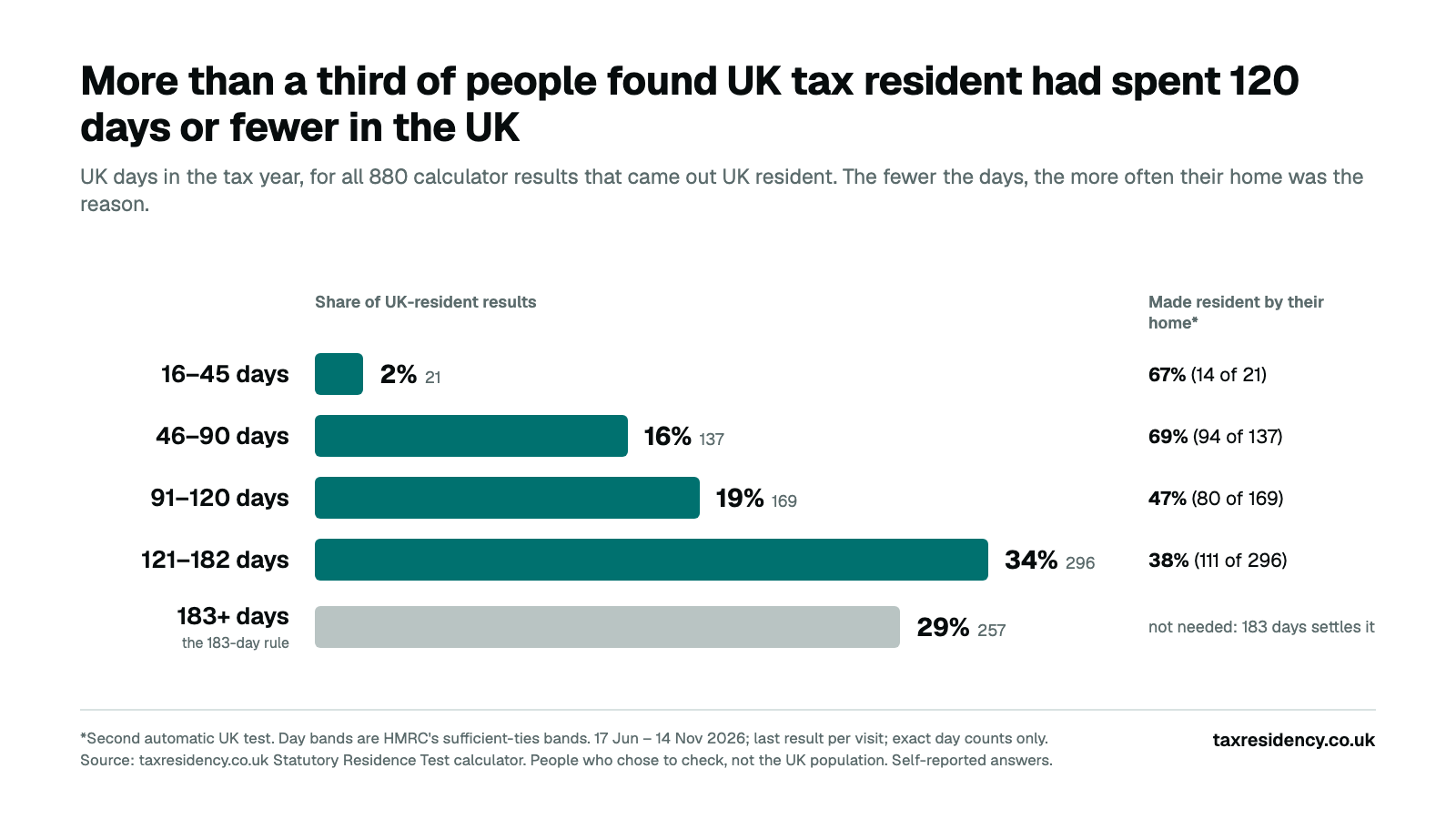
- More than a third (37%) were resident with 120 UK days or fewer, and the fewer the days, the more often it was the home test: 69% in the 46-90 day band
- 39% were resident because their UK ties lowered the number of days that counts, and 13% because they worked full-time in the UK
- People HMRC calls "leavers" (UK resident in one of the previous three tax years) who were still resident under 183 days had a median of 119 UK days
- Among leavers who came out non-resident on their ties, 23% were within 5 days of becoming resident
The numbers
Between 17 June and 14 November 2026, 2,368 visits to our calculator ended in a result based on an exact UK day count. 880 of those came out UK resident, and 623 of the 880 had spent fewer than 183 days in the UK: 71%.
The share held steady month to month:
| Month (2026) | Resident with under 183 UK days |
|---|---|
| June (from 17th) | 71% (40 of 56) |
| July | 75% (188 of 251) |
| August | 73% (135 of 184) |
| September | 67% (107 of 160) |
| October | 68% (114 of 167) |
| November (to 14th) | 63% (39 of 62) |
It holds for both groups HMRC's tests distinguish:
- Leavers, UK resident in at least one of the previous three tax years: 69% (419 of 608)
- Arrivers, not UK resident in any of the previous three tax years: 75% (204 of 272)
For leavers who were resident despite staying under 183 days, the median was 119 UK days: about four months, well short of half a year.
How few days?
Grouping the 880 residents by their UK days, using the same day bands as HMRC's sufficient ties test, shows how far below 183 days many of them were:
| UK days in the tax year | Share of UK-resident results | Made resident by their home |
|---|---|---|
| 16-45 | 2% (21) | 67% (14 of 21) |
| 46-90 | 16% (137) | 69% (94 of 137) |
| 91-120 | 19% (169) | 47% (80 of 169) |
| 121-182 | 34% (296) | 38% (111 of 296) |
| 183 or more | 29% (257) | not needed: 183 days settles it |
More than a third (37%, 327 of 880) were resident with 120 days or fewer, and 18% (158) with 90 or fewer. Of those under 183 days, about half (52%) had 120 or fewer.
The fewer days someone had, the more likely it was their home that made them resident. In the 46-90 day band, 69% were resident under the home test; at 121-182 days, it was 38%, with the sufficient ties test deciding more of the rest. Everyone in the 16-45 band was a leaver. That's expected: an arriver (not UK resident in any of the previous three tax years) with fewer than 46 UK days is non-resident under the second automatic overseas test.
Why they were resident: usually the home
The Statutory Residence Test isn't one rule. HMRC's guidance sets out an order: the automatic overseas tests come first, and if one is met you're non-resident, unless you've spent 183 days or more in the UK (RFIG20110). Then come three automatic UK tests, and finally the sufficient ties test.
For the 623 people who came out resident with fewer than 183 days, this is the test that made them resident:
| What made them resident | Share | Median UK days |
|---|---|---|
| Second automatic UK test: their home | 48% (299) | 106 |
| Sufficient ties test: their UK ties | 39% (245) | 130 |
| Third automatic UK test: full-time UK work | 13% (79) | 120 |
The home test on its own accounts for nearly half. And the people it caught had a median of just 106 UK days, the fewest of any group.
Having a home abroad wasn't enough to avoid it. Of the 299 people resident under the home test, 203 (68%) said they also had an overseas home. For the test to apply anyway, they must have spent fewer than 30 days in that overseas home during the tax year, or had a stretch of at least 91 days, with at least 30 of them in the tax year, when their only home was in the UK. The home test decided 60% of arrivers' results (123 of 204) and 42% of leavers' (176 of 419).
The home test, in plain English
HMRC's manual describes the second automatic UK test as relevant "if the individual either has or had a home in the UK during all or part of the relevant tax year". It's met if there's at least one period of 91 consecutive days, at least 30 of which fall in the tax year, when you have a UK home and spend enough time in it, and also:
- you have no overseas home, or
- you have an overseas home but are present in it on fewer than 30 days in the tax year
"Enough time" in the UK home means being present there "on at least 30 days" in the tax year, and those days "do not have to be consecutive" (RFIG20340). Any presence counts, "for no matter how short a period".
Nothing in that test is about 183 days. It's about whether your home is in the UK. That's why it catches people who are watching their day count closely:
- Someone leaving the UK who keeps their UK house and hasn't yet set up a home abroad, for example by travelling, staying with friends or living in short-term lets. HMRC's own example is a retiree who spends a year travelling, keeps her only home in Cheshire and is there on 41 days; she's resident under this test.
- Someone arriving who sells their overseas home and moves into a UK home. Once they have only a UK home for 91 days, and are in it on 30 days, the test can be met.
- Someone with homes in both places who spends fewer than 30 days in the overseas one. For this test, HMRC says a home used on fewer than 30 days can be disregarded (RFIG20360).
What counts as a "home" has its own guidance (RFIG22110), and it's one of the harder judgments in the whole test. Our second automatic UK test guide covers it in detail.
Ties: the day limit is lower than people think
The next biggest group, 39%, were resident under the sufficient ties test. It doesn't set one day limit, it sets several. The more ties you have to the UK (family, accommodation, work, more than 90 days here in either of the previous two tax years and, for leavers only, the UK being the country where you spent the most time), the fewer days it takes to make you resident.
For leavers, HMRC's Table A (RFIG20520) works like this:
| Days spent in the UK | UK ties needed |
|---|---|
| More than 15 but not more than 45 | At least 4 |
| More than 45 but not more than 90 | At least 3 |
| More than 90 but not more than 120 | At least 2 |
| More than 120 | At least 1 |
So a leaver with two ties is resident from 91 days, and one with a single tie from 121 days. The full tables for leavers and arrivers are on our UK day limits reference page.
The near-misses
Plenty of people who came out non-resident were closer to the line than they might have assumed. Among leavers whose result was decided by the sufficient ties test and who came out non-resident:
- 23% were within 5 days of the limit that would have made them resident (69 of 303)
- 31% were within 10 days
- The median margin was 35 days
A few extra days, a delayed flight or an unplanned trip can be the difference. HMRC counts a day in the UK if you're here at the end of the day, at midnight (RFIG20710), with some exceptions and a deeming rule that can count extra days.
What this means if you're checking your own position
This isn't advice on any individual situation, but the data points to a few things worth checking before relying on a day count:
- Check the automatic overseas tests first. If one applies, you're non-resident and the rest doesn't matter (unless you have 183 days or more).
- Check where your home is. If your only home is in the UK, or you barely use your overseas one, the second automatic UK test can make you resident with far fewer than 183 days.
- Count your ties, then your day limit. Your ties set the number of days that matters, and for many people it's well below 183.
- Count days the way HMRC does, at midnight, including any days the deeming rule adds.
The free calculator works through the tests in HMRC's order and shows which one decides your result. For anything borderline, or a situation the tests don't neatly fit, speak to a qualified tax adviser.
About the data
Source: results from the free Statutory Residence Test calculator on this site, 17 June to 14 November 2026.
Method:
- We counted one result per visit: the last one, so someone trying a few variations counts once per visit.
- We included only visits where the person typed in an exact UK day count. Visits where someone picked a range (such as "91-120 days") are excluded, because a range doesn't give a precise number.
- The calculator applies the tests in HMRC's published guidance (RDR3 and the Residence manual). "What made them resident" is the first test, in HMRC's order, that the person met.
- Day counts are the calculator's, so they include any days added by the deeming rule.
Caveats:
- These are people who chose to check their residence, often because they were unsure. They aren't a sample of the UK population or of everyone who files a UK tax return.
- Answers are self-reported. Questions like whether a property counts as a "home" are judgments, and people can get them wrong.
- Some visits will be "what if" scenarios rather than someone's real situation.
- The site doesn't use cookies, so someone who comes back on a different day counts again.
- A calculator result isn't a ruling from HMRC.
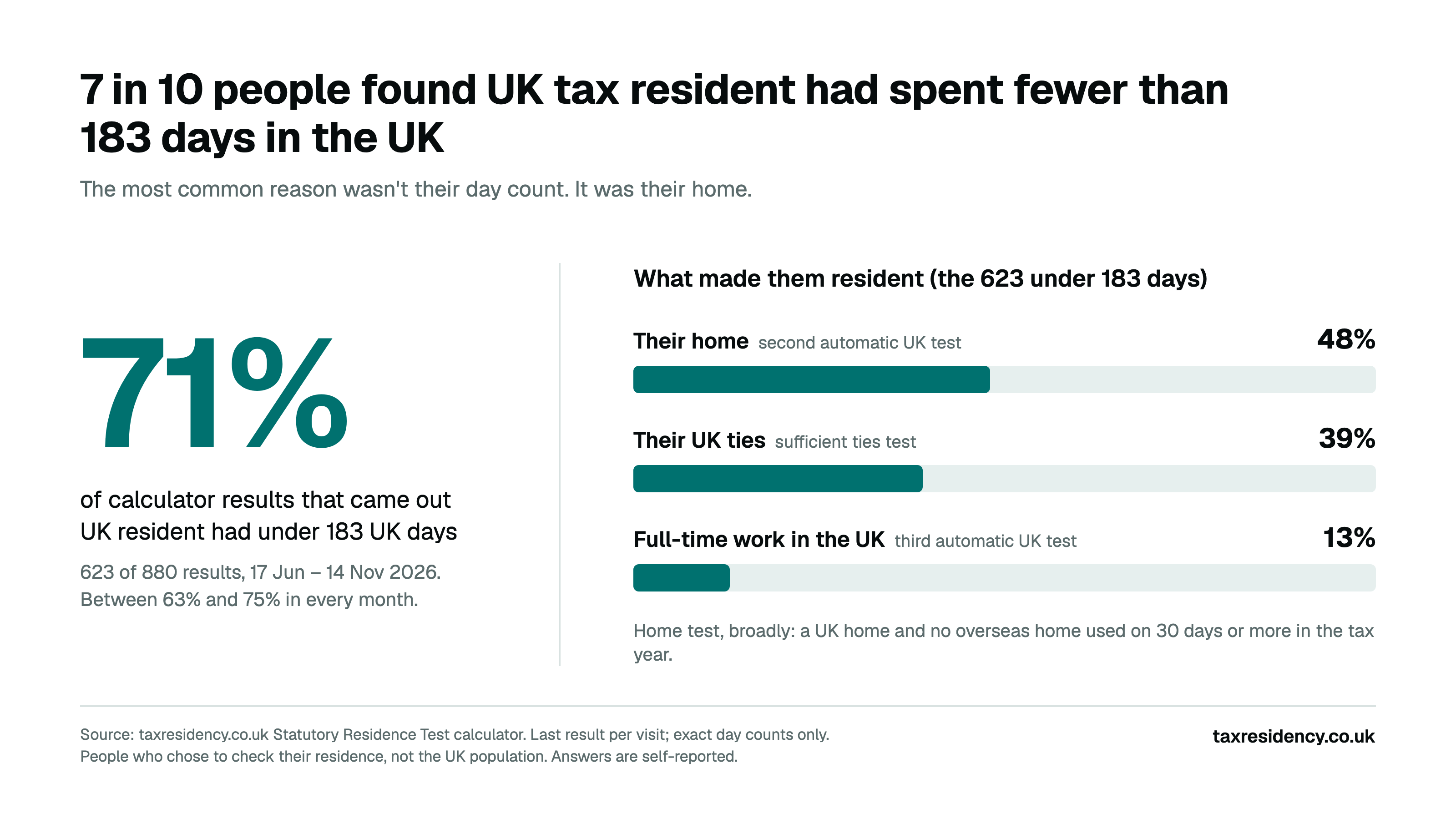
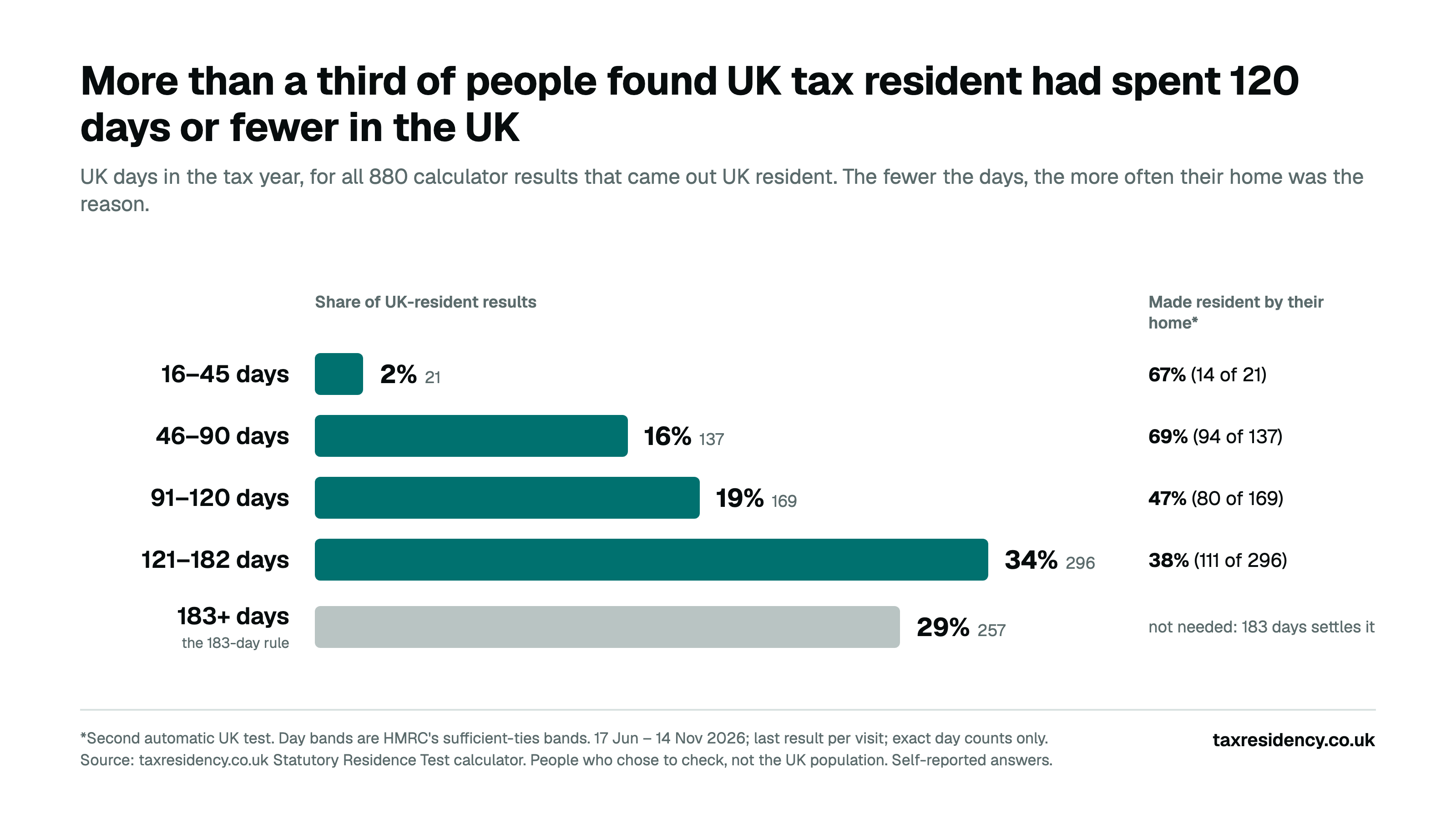
Using these figures: you're welcome to quote them. Please describe them as calculator data, as above, and link to this page as the source. Both charts are free to use with the same credit. Download them in high resolution (PNG, 3200 × 1800): 71% under 183 days and residents by UK days.
Related
Try it out for yourself
These figures come from our free calculator. Enter your own UK days, home and ties to see where you stand, and which test decides it, worked through in HMRC's order.
Try the free calculatorFurther reading
15 September 2026 · 8 min read
NT Tax Code and Form DT-Individual, Explained
What an NT tax code means, the two routes non-residents use to get one - the P85 and Form DT-Individual - and why the Statutory Residence Test is the gateway.
3 September 2026 · 10 min read
Non-Resident Landlord Scheme: How UK Rent Is Taxed
The Non-Resident Landlord Scheme explained - who deducts tax from your UK rent, the NRL1 gross payment route, and why it doesn't use the Statutory Residence Test.